Quickstart
Setlist requires macOS, Linux, or Windows 11 with Git for Windows, and bash, git and jq on PATH (jq 1.7 or later on Windows). Without jq every governed commit is refused.
It requires Claude Code 2.1.193 or later, for the marketplace rename and the fallbackModel chain. The deny mechanic is verified on 2.1.200 and later, the re-grounding pointer reaches a resumed or continued session whole from 2.1.277, the stamped deny and ask rules hold under sandbox auto-allow from 2.1.289, and from 2.1.295 the bypass deny blocks a command when it times out or cannot start.
Install the plugin from inside Claude Code, then run session zero in your project on opus, or on the escalation tier of the model ladder for a complex project: fable in the edition's Part 2 table, or best without Fable access. Day-to-day building runs under /model opusplan. /setlist:validate re-runs the opusplan probe in both phases.
It names a phase served by a model outside its tier, which a managed model allowlist changed after the stamp can cause, or by a model other than the one the stamp recorded. No plugin? Copy the edition's three files (setlist.md, setlist-operations.md, setlist-changelog.md) into your project and ask a session on opus (or on the escalation tier for a complex project) to run its bootstrap, retrofit or upgrade protocol.
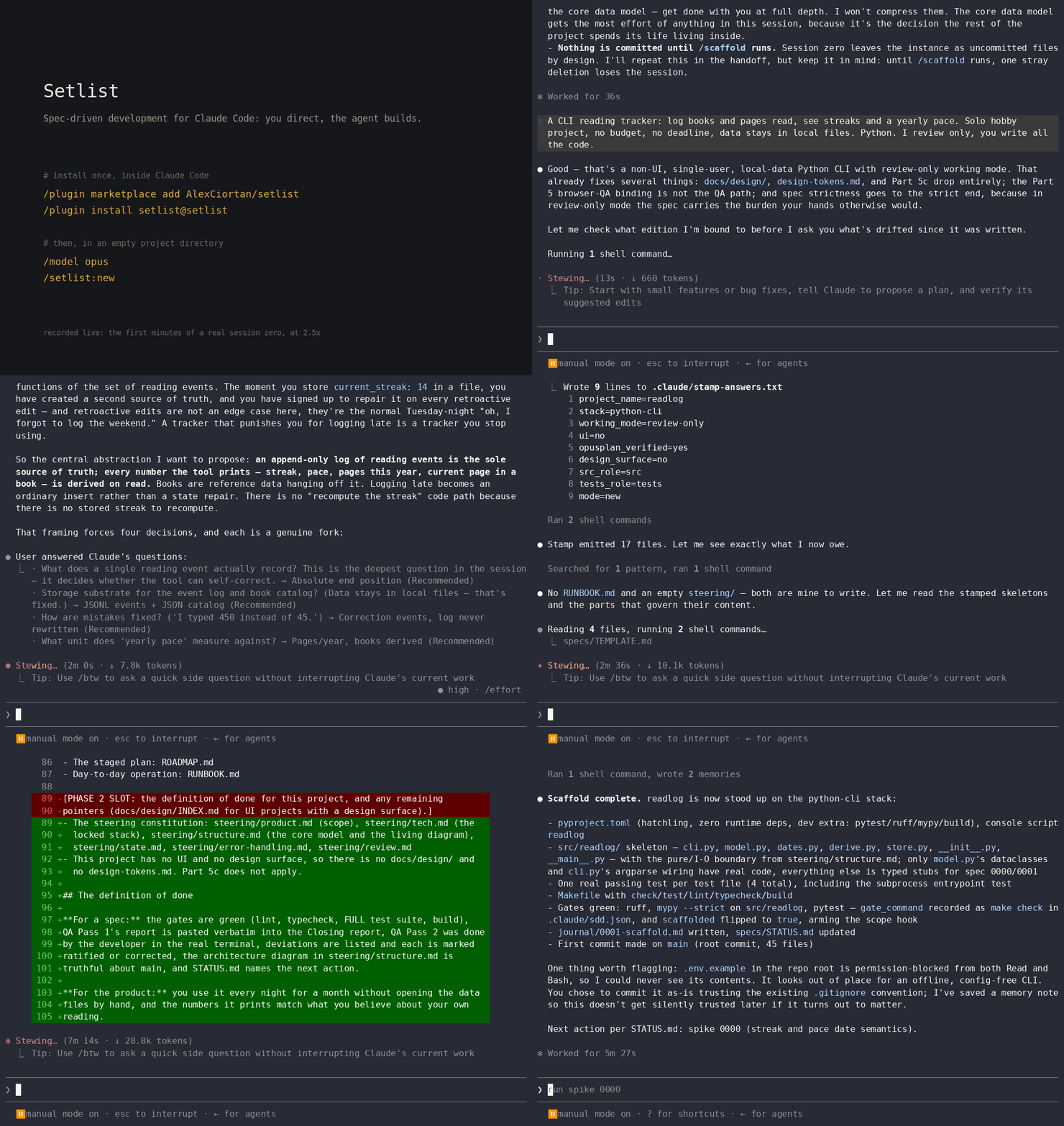
/plugin marketplace add AlexCiortan/setlist
/plugin install setlist@setlist
/model opus      # or: /model fable for a complex project
/setlist:new     # an existing repo: /setlist:retrofit; an older instance: /setlist:upgrade
Before you adopt Setlist, observe mode, /setlist:retrofit --observe, shows what it would do. It reads an existing repository's last 50 merges and prints every one the trunk audit would have refused, by commit and code, and it installs and writes nothing. On an instance, /setlist:upgrade prints the same reading as a verdict delta between the audit you have and the new one, both ways, before anything is replaced.